
Bereket and the county of Ammerland or "Will happiness find me?"
Where sugar is called Kluntjes and does not sink to the bottom of a teacup but swims in it like an iceberg, there is Ammerland.
"There is a young man from Berlin with me, who has build a lot of thatched roofs in Africa." Herman Rust is talking deliberately on the phone. The view from his office window is directed to the gently sloping surfaces of a thatched roof. There are hardcopies of Bereket's Agedo roof on the architect's table; that roof Bereket constructed in summer in the tradition of Eritrea, his country of origin, in the garden of Museum Europäischer Kulturen, turning it into a sculpture.
50 kilometers East of the timber-framed working farm Rust is the municipality of Elsfleth - one of the oldest municipalities in all of Wesermarsch. This is what they call the land in this area of Nordrhein-Westfalen. Only a few hours later Bereket will say: "This is not Germany - it is Eritrea."
Along Bardenfleth windows are twinkling at visitors from underneath lashes made of thick layers of thatch. They look more like hills, swinging over walls to protect each house's living area, than rigid roofs. Maybe this place, where the roofer Uwe Thormaelen has his business, inspired the architects, who invented the houses of hobbits, as we saw them in movies. Were those thatched roofs of Elsfleth a model when looking for an architectural expression of Gemuetlichkeit, protection and reliance?
"I am Bereket. I am from Eritrea. I am a roofer. In Eritrea I have been building thatched roofs for eight years and I was trained for a year. Thereafter, I worked on my own. A roof is finished within four days. In Eritrea, I build 150 roofs in eight years."
65 people work in Uwe Thormaelen's business, which is specialized on thatched roofs and the maintenance of roofs. There is high demand. Once favorable material with the poor as it was available in nature and therefore cheap, houses with thatched roofs nowadays express prosperity.
It is a Friday afternoon, when we walk over the premises to the shelters where all material is stored, sorted according to its quality and origin. The reed bales come from China, Hungary, and out of the region. "This is beautiful," Bereket says, posturing in front of clustered sprigs.
The roofer from Eritrea has been living in Berlin for almost two years now. He likes the city, the people. Only the roofs spoil an almost perfect picture for him: in Berlin roofs are not covered with reed or straw. Bereket's skills are not required. Authorities sent him to a canteen kitchen for an internship.
On Saturday, fall was golden, seducing Bereket's senses: those houses of clinker, the open country, and the shelters with agricultural equipment - everything seemed to remind him of his former life. He would have loved to go horseback riding on one of the grazing horses. Reed maze is eatable, he taught us. A few pretty houses along the way made him reinforce what he had said before: "This is not Germany, it is Eritrea."
We had spent the night in Giesselhorst. At the façade of the house on Langen Weg (i.e. long path, name of street) it read: "Moin Moin."
"M-O-I-N?" - Bereket deciphered the word he never heard before. We explained to him that this is what people said in the area to greet each other, regardless of the time of the day. And while we strolled through the countryside, we challenged each other to greet everyone coming our way with a cheerful "Moin-Moin." Much to Bereket's surprise and as a matter of course, this was echoed by cyclists and strollers alike with "Moiiiiiiin." It made Bereket giggle.
In the evening hours on the balcony of our vacation rental - and moved by the unforgettable experience he had made during the day - he had talked to us about his life in Eritrea before his escape: "I had everything. I was rich. I had a wife. All was well." His work had made him a respected man.
"Will happiness find me?" - the most beautiful of all questions was once asked by the Swiss artist duo Fischli and Weiss.
Bereket's roof at the garden of the museum affected a visitor to make contact to experts in Nordrhein-Westfalen - to the place where Rainer Ohlinger1 grew up, where sugar swims like an iceberg in the teacup, and where roofs are covered with reed. Five hours away from Berlin.
KUNSTASYL travelled to this "not Germany but Eritrea" with the question whether the skills of a roofer from Ghergef can be combined with those of a reed roofer in Ammerland.
Today, we have received an email send by the roofing company Thormaelen in Elsfleth: The company invites Bereket to do an internship with them. This may be the first step towards future with the possibility of an apprenticeship.
Happiness found him.
He was visible.
1 Rainer Ohliger, born 1967, is a historian and social scientist. His main subject and passion are historical and international migration, interethnic relations as well as history and memory within an immigrant society.
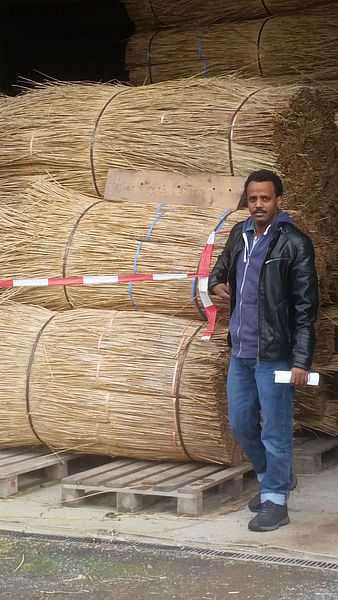
Bereket vor Schilfballen auf dem Gelände des Reetdachdeckers Uwe Thormählen
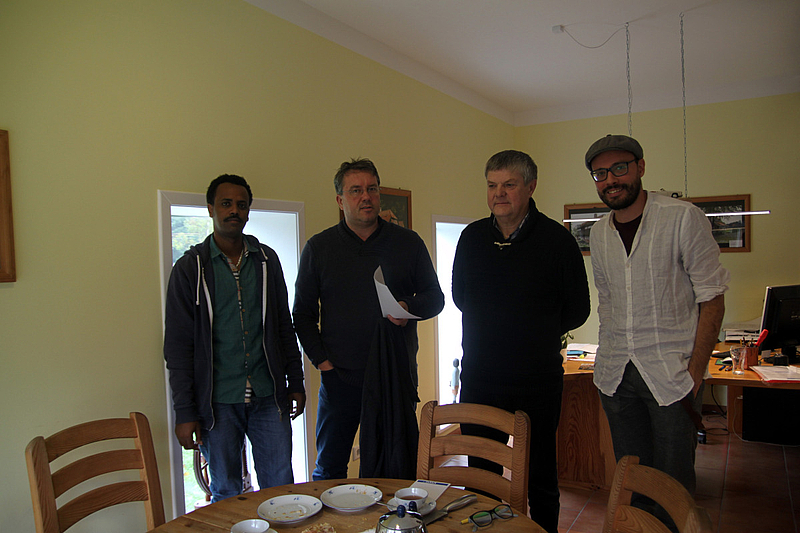
Bereket Kibrom, Rainer Ohliger, Hermann Rust und Aymen Montasser im Büro des Architekten und Bauplaners in Westerstede

Neueindeckung eines Einfamilienhaus mit Reetdach in Bremen
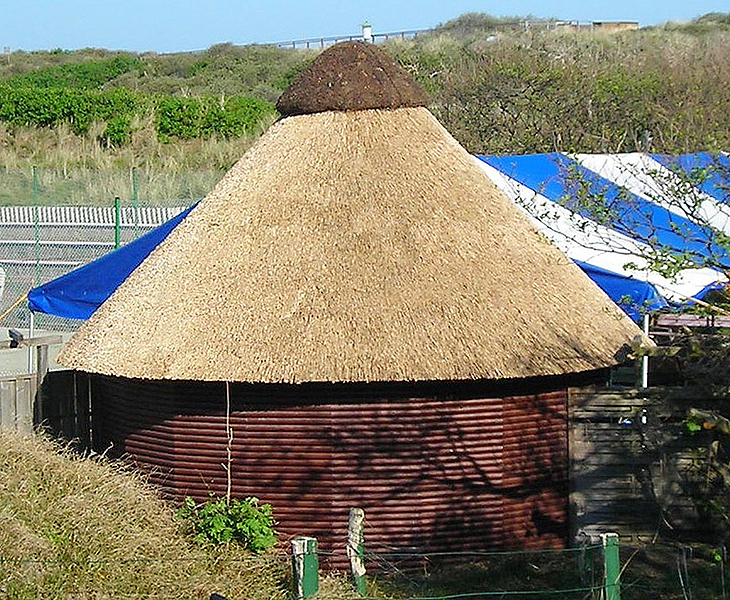
"Das ist nicht Deutschland, das ist Eritra" - Neueindeckung Reetdachpavillon
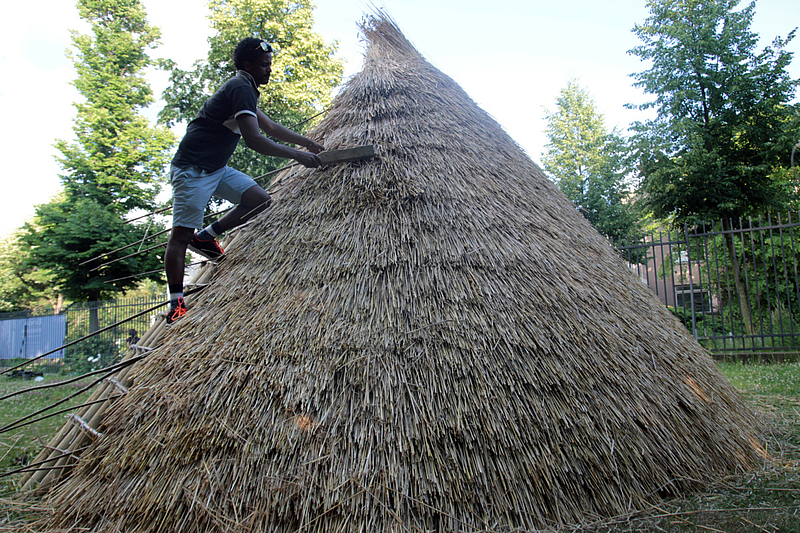
Bereket beim Bau seines AGEDOS im Garten des Museums Europäischer Kulturen
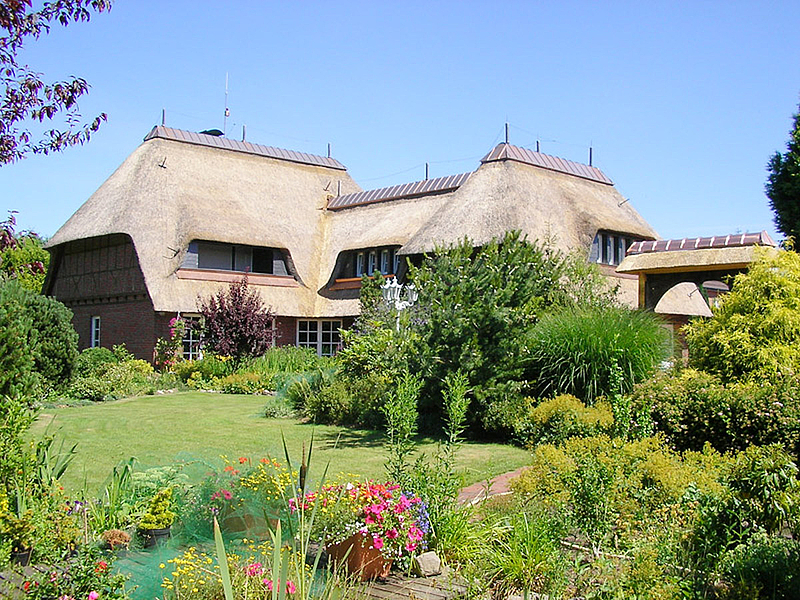
Sanierung eines Reetdaches und Erstellung einer Kupferfirst
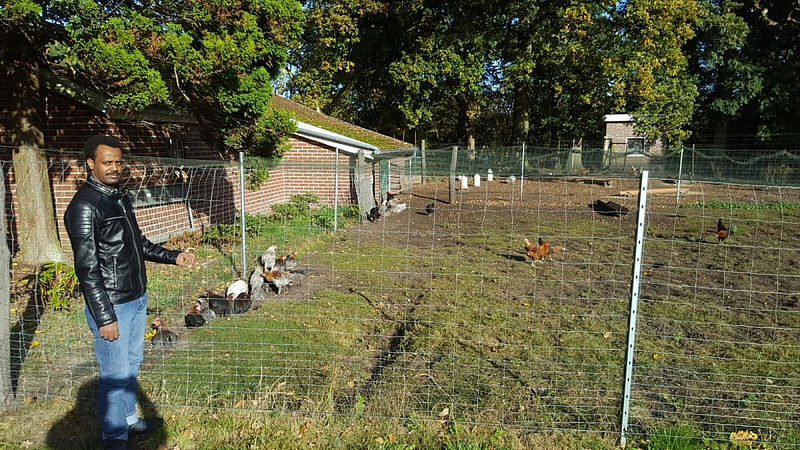
"Das ist nicht Deutschland, das ist Eritra" - Hühner in der Nähe von Gießelhorst im Ammerland
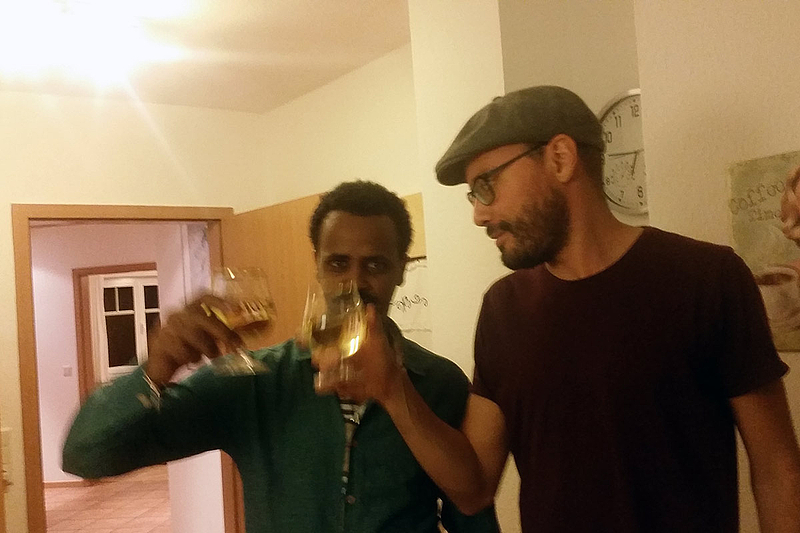
Megedi tiihna amet kida | መገዲ ትዕና ዓመት ኪዳ | Nur mit Geduld erreichst du dein Ziel. Bereket und Aymen - zwei Freunde.