
205 MUSAAB
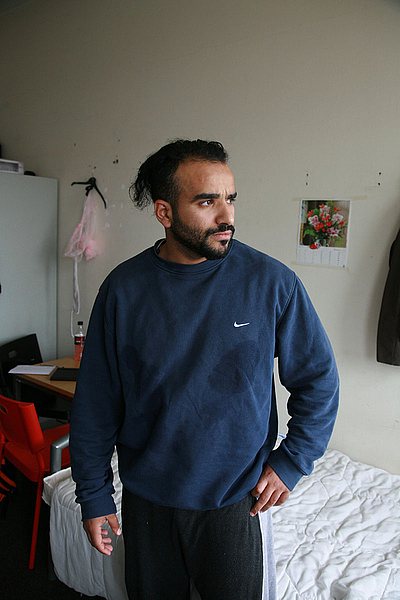
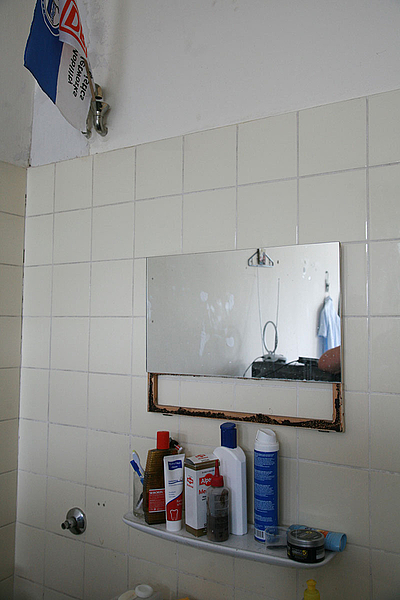
Musaab spent nine months in the shelter in Staakener Straße. After enduring an Odysee of apartment search he will finally move to a 1-Zi-Kü-Bad - flat on July 1th.
The conversation with Musaab has taken place aqt May 31, 2016
"Now, what would you do if France were to occupy Zurich or Geneva?"
There are only 80 kilometers between Damascus and the Golan Heights. The rolling country, occupied by Israel since 1967, is still recognized as Syrian territory. "You would hate France. That's how it is when your homeland is concerned."
Musaab's family is from Golan. All ten siblings were born in Damascus. All their lives they have known the desolate place with its high strategic importance only from their parents' narratives. "This is our land" - lost homeland I. If you want to drive all the way from Damascus to Golan, it will probably take 43 hours of driving for 2,766 kilometers. At least, if you take the official route Google maps is recommending. One can be faster, depending on the risk you're willing to take.Musaab and his family would lead an ordinary life. The life of an ordinary Syrian family, he says. With the only exception, that all of them - from his father to himself, the youngest of the bunch - studied French. That made them stand out.
Until the day he fled. He had been waiting for three years, observing the situation. He would have needed just one more year to graduate. A degree would have offered a better future. At a foundation he would teach children in art and painting. At 27 he fought for an ordinary life, working hard, studying, until he could no longer pass the street to university, until he would strand at checkpoints. When every day life fragmented, when people died in conflicts, two hundred, hundred, sixty - a new number every day, women and children among them. "They did not carry guns. At least children and young people should be granted clemency. Two hundred countries worldwide are incapable to stop this war. We're victims of everyone's interests."
He did not think much further than crossing the Syrian border. By bus and nonofficial cabs he escaped to Lebanon. However, that was no place for him to stay, with its environment beyond all bearing, its inacceptable conditions - socially as well as politically. He would make some money and move on, all the way to Turkey.
For seven hours the boat would float on the sea, no light and no land in sight - the Turkish coastline as distant as the Greek islands. When arriving at Samos his conscience was weak. With fever and shaking chills he fell into delirium. All along his escape there was the cold. April would assault him.
He found medical help in Serbia. He would follow the footprints of those who had spend the nights in the woods, struggling their way through the Balkan, orientating themselves along the course of a river and crossing mountains. Tramping through snow. Afraid of the police, the fingerprint, the police enforcement cameras.
The family's house at Kafr Sousa, a district of Damascus, does no longer exist. Bombs destroyed it. The memory of a childhood shared in one room with his brothers, their passion for cartoons, the daily meals are all that is left.
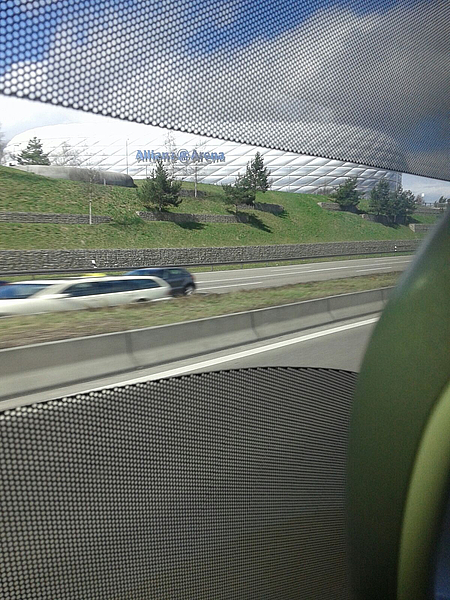 His journey into the dark would last one month. When he finally opened the car door he stood in Munich. "And do you have any idea what I really wanted to see? Allianz Arena - the stadium of Bayern München. That was a dream. I really wanted to take a picture with me in front of Allianz Arena. I stayed for only three hours. Then I took the bus to Berlin.
Those 30 days had been so exhausting. All I wanted was to relax. To come to rest. What ever may happen to you in Germany - you are in no danger.
I stayed for only three hours. Then I took the bus to Berlin.
Right after arrival, someone took us to LaGeSo. It was 11 o'clock at night. It was so very cold. I will never forget how cold it was. I spent the night at LaGeSo. There was a small tent but it was too cold. When spotting a nearby hospital I decided to go there. The cold was unbearable. We would lie down on the floor. But a 3 o'clock in the morning a security man showed up with his dog. He would release the dog and the dog came after us. We were told to wait outside, as waiting inside was not allowed. Okay - we slept outside. From 4 am to 10 am. Then we went inside LaGeSo to register.
We were not sent to an asylum but to the balloon, that big tent. From the balloon to Hohenzollerndamm, then Rohrdamm, followed by a hostel. It was more of a horse barn but they called it a hostel. It was no housing for humans. Then I came here. I have been here for nine months.
It has been so difficult to wait for so many months. My friends were given their residence permit a lot earlier. Those hours in front of LaGeSo from dawn till dusk, until they call your number. You go insane.
You are loosing the day. You must not think, you must forget. There is just one thought: when can I go in and when can I get out?
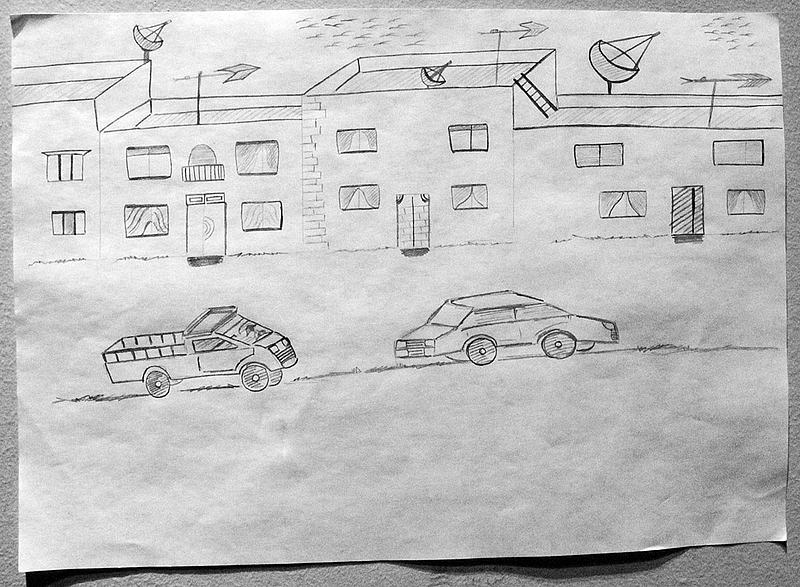
Now I have an apartment. That is so very important to me. My next step will be to go to school and to learn German. Then I'll see whether I go back to university or do an internship or start an apprenticeship. I really want to focus on things I need to do and things I would like to do. Everyone needs privacy and stability. Everyone.
Everywhere I stayed I was never alone. There where three, four, five others. A huge number of people. You want to study, you want to focus on your life, and you need to think about all those things that you need to do. When you study a friend a friend will listen to music or has somebody visiting - that will make you crazy and all confused. Now that I have an apartment - I sure hope this will be the beginning of something good.
My life … what can I say. I am grateful to God for being lucky. So many people die because of war. Many children, women, young people. So many are killed. To be here means I am lucky. This applies not only to Syria. It is the same with war everywhere: once you escape you are lucky. And everyone listening to what I say should think about life and be grateful to be able to live in peace. Once you live in peace there is nothing you can't do. During war your life stands still. You have to start over. That's how it is. When thinking about all those people who died due to circumstances, people who are not to blame, then you know how lucky you are."
Milad
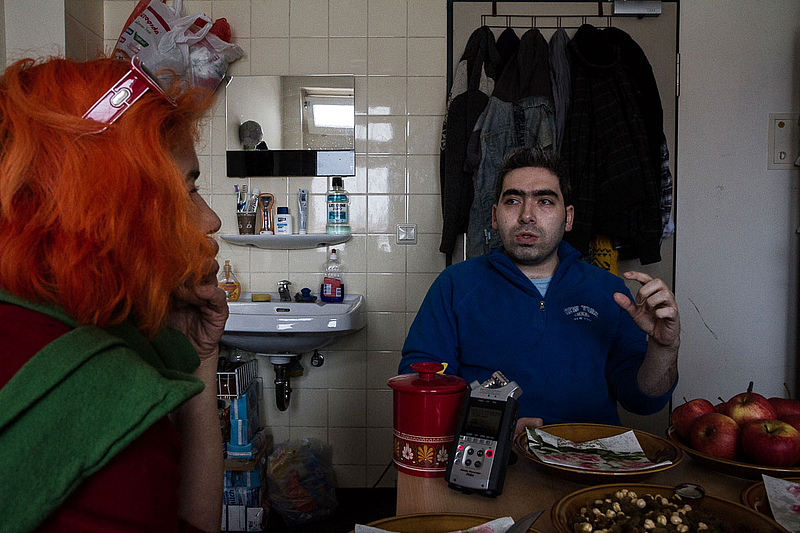
Looking forward to our visit, Milad had carefully set the small table. There were napkins with rose design on each plate. A bright red pyramid of apples would glow, forming a lovely contrast to the airy pile of chips, and a plate filled with nuts and raisins.
Milad is aware of the fact that I'll record our conversation, to keep his story as one of the first residents at the asylum. His story, that made him a political refugee from Iran.
You know, it's my life. I keep thinking, okay, tomorrow when I wake up I have to succeed and I try. At this moment, I do not think of tomorrow, I think ten days ahead.
But sometimes, when I wake up and when I try to succeed there are so many obstacles in my way that force me to stop.
That is very depressing and I have the feeling … it is difficult to say that, however … I do not want to live anymore. I don't want to live. It's because … I have had a good life. It is destroyed now and I don't see my future life any more.
That's an awful feeling.
It's not only me; most people who live here (at the asylum) feel that way.
Every now and then we try to cheer each other up, but it won't work.
For example now … I am sitting here and I smile but there is no happiness behind my smile.
While we remain silent, Milad asks all of a sudden, "Why don't you eat?"
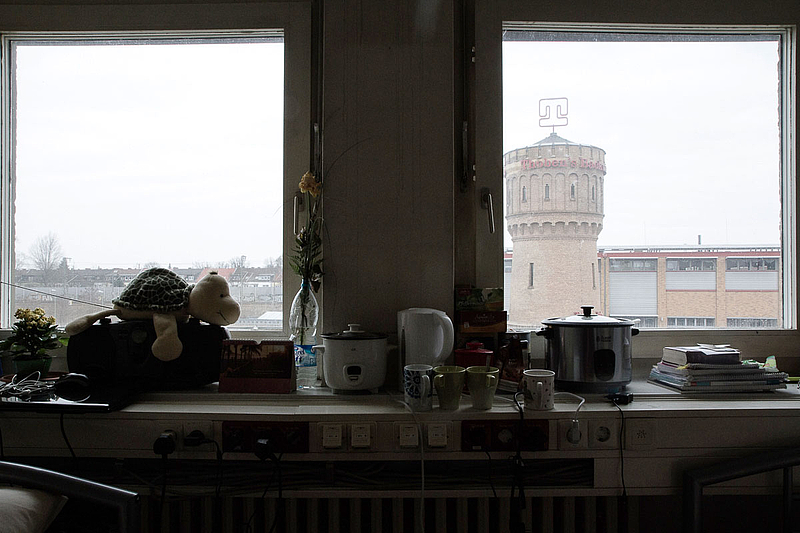
Each of us takes an apple. A big plush turtle is sitting on the windowsill.
Milad: "My most beautiful memory? The family. We were always together. I have a father, a mother and one sister and a brother in law. We were always together. It's a beautiful image of my memory. When my sister got married, she was seperated from us and went to her house. She got married four years ago. But always, every two or three days, they came to my fathers house and we spent a lot of time together. It was a small apartment, about 70qm², with three rooms a hall and two bedrooms. In Iran, it's our culture, when you have a family, you don't go and live along. It's a rule of family in Iran. And because of that, many children stay with their father and mother. And when they get married, they seperate Not all of them, but many of them.
When I finished High School, I started working and studying at university. All my day was busy with this procedure. I was working or studying till 7 o'clock in the evening and when I came back the rest of my day I spent with my family.
My father worked as a navy but my mother was a housewive.
First he worked on a ship, he studied as an electro mechanic. It was about the electricity of the warship. After that.. you know, in the military service, every year you get a new rank. There is a department in the navy called „university to the navy“ and make a new solution for the navy. They started a new project. My father worked in this places and had a connection between university and the navy. It was a short time, near four months.
What was the problem? I told you, my father was a navy. He went to navy in the duration of Shah, not in this Islamic Republic. And my father was always against with the Islamic Republic.
In duration of my life I was interested in politics, my father was speaking about that. Because of that, I started reading about politcs, I started to... not serious work.. Some part was speaking about what we should do for our country, or what we can change about our country, or give a vote, push politic people to our way. You know about what happened in Iran five years ago? About the revolution... Until that time, we started speaking, went to every groups and say what we think. But after that time, when me and my friends saw, it's not possible to go the correct way, we changed our way. You know sometimes... for example: you know about politics but I don't know about politics. In this situation, when I want to go to say to this people, it's better to stay in another country, I'm the dangerous person, because I don't know the politic. So, when you know about the politic, you must give me information, you must make my brain for politics.
Me and my friends started to make like that. We tried to make a webpage and invite people to our webpage and started speaking, what is the politic. Unfortunately Islamic Republic Iran, the government doesn't let people understand about politics, because when they want to do something, the people understand what happens and they can't. Because of that, in University most students mustn't know about politics, what is that and what ist that. But the Islamic Republic cut all the way, saying „No, nobody need to understand what is politics and you don't need that.“. There is a special group in our country. They decide which people are good to come and sit in presidents chairs. You can not select the best person. They say, okay, there are three persons, come and select one of them. And they say, that's democracy. But this is not democratic. We tried to make something light for people and two years ago, before I came here, they understand from which situation we connect to the internet and that we write something on that webpage. And after that, there was some problems and I tried to escape.
If the people want, yes there is a way. But sometimes, some of the people don't want to, because they don't understand what happened in that country. A better way to sit people in their chairs, make them busy with other things. In Iran the other thing is Islam. It's about the religion. Make people busy with religion and I can tell you, most of them are worried about when the Islamic Republic change, they can't live as a Muslim. They are worried about that. And sometimes in politics money speaks. And there are many people, who take a lot of money in this situation. And they don't want people to change it. This is the problem.
At the first, there was the family, my family in Iran. After that I tried to go to politics. It was the biggest. There were many things, but they were small. My life is... I have a small apartment with the family, a woman and one or two children. I want a small job, not a big one, so I can have more time with my family, not with my job. Sometimes we go to other countries, not a lot.
It's my image of my life.
Here after two years, I'm confused, I can't find my way, I don't know... In Iran I lived near 25 years and I make my life there. But here, now, I started to make it again, like 25 years again. I don't know which future waits for me. And I don't know, can I make it like there or no? In Iran I have many chances, because I made it. But here, I don't make anything and I don't know if I have the chance to do it or no. Now I have to start again. For example in Iran I have my job, I have my studying. But here the government says no, our studies, we don't believe that. And you must again study, you must again work. I can't find a workplace like before that I like. Now I am 28 years and it's a little bit hard to again study in my profession.
When I found people to help me to go out from Iran, they don't say we go to our country. They said, you just have one chance and it's Canada. I understand why he told me Canada. Because it's far away and he can take good money for that. When he told me to come here in Germany, he leaves me. It was a very bad situation that time. A bad thing happened to me, there is a problem in Iran, I came here, this people leave me here and don't reach me an other country. Okay I know a little bit english, but I don't know german. What should I do here? There were many problems first. I tried to find this person again to help me to go there. But I can't find it. First I was in Hamburg. I have an uncle here, but we don't have any good connection together. When I see, I don't have any chance, I made a call with him. There is a special company here, it's an iranian group, a politic iranian group. My uncle told me ok, here is their telephone number and they can help you. I said ok. I made a call with them and they told me, it's better to stay here, you go to the police. It's the better way if you stay here. If you can't go back to your country and you can't go to Canada, what should you do? You have to stay here. I said okay.
This group gave me the telephone number of a lawyer. I called the lawyer and he told me, come to me. I went to the lawyer. He gave me a paper to give to the police. And he told me it's better... You know, there is no special group for asyl-people in their cities. For example: When I introduced myself to the Sozialamt in Bremen, they said I have to go to Berlin. When I came to Berlin, I introduced myself here, but they said no, you have to go to Munich. My lawyer said, in this time, it's better you go to the east. Introduce yourself in the east, to send you to the west. I want to be near to my lawyer. […] Now I'm here. To far away for me to go every month to my lawyer and come back. It's a little bit hard. I told him okay. He said „I think it's better to go to Berlin, your uncle is there. Ok, you have a problem with your uncle but he can help you. There is something here. There is a problem, but it's your family.“. I said, ok, I came here, introduced myself to Sozialamt. But Sozialamt said no, you stay here. And yes, I'm here and my lawyer is in Berlin. But I can tell you about my family... I don't like to say that, but after two years I don't have any call from my uncle. My uncle is in Berlin. In our family there is a problem between him and my father. They chose this way, I can't change it.
I don't have any passport or any ID card. First I came here with my passport. This person took my passport and said I will give you another passport, wait here. He went and didn't come back. And now I don't have anything to stay here, to show who I am. I have an Iranian card for military service, it was with me. I went to the police, they said, give me your ID card. I gave them this one, but the police said „What is that?“. I spent two years in military service. In a bad situation like this to take this one - „What is that“, they said. It was really bad, I lived in the U-Bahn for two days. It was really really bad. If I knew I have to stay here at the first time, I would have gone to the police. But at that time, I was confused, what should I do. I don't know what to do. I should sleep in the streets for three days. And after that, it goes well, step by step.
People in the street helped me to find my way, for example for this Heim, I have a paper saying „Staakener Straße 79“. When I came here, I didn't see the number of this house. I went to the end of this street. At the time, it was about 4 o'clock. There were no people on the way. Fortunately, at the end of this street about 500 meters, a person came this way. I asked him, where is this adress? And he helped me.
The first time in this Heim was really perfekt. Why? It's not the first Heim I came. I introduced myself to the Sozialamt and LaGeSo on friday. On friday Sozialamt was closed and sent me to the police. The police said, you have to go to Montardstraße. I lived there for three days and it was really bad. I couldn't go out from my room these three days. I stayed in my room. I was shocked: what is here? It is a house for people to live? It was so dirty. It's better I don't speak about that. On monday I went to LaGeSo again and they sent me here. And when I came here, it was really beautiful. It was very clean. I was suprised, thanks God, ihere is clean. It's really good. Yeah, after two years, it goes a little bit down. But the first time it was really good and i can tell you, after one week, I could sleep like a human in this Heim. It was really good.
There are many times I lost my life. I was depressed. There are many times I got up. There are many times we are happy or we were sad. I never forget these two years. In two years I can not make friends. It's not important about the girl or about the boy. This is really hard. The people who live in this situation, all of them feel bad and are not happy. So you have not a chance in this situation to make a friend. In the street it's the same again. People, I don't know why, they are worried about the people who come in this situation. You are Asyl and are new tin these places. And it makes it really hard to make a connection with the people. I always go to the sociality but never have a chance to find a friend.
It's really hard to imagine. It is really hard to imagine, but.. Always there is black content in your eyes. It's a problem. I try to make it, but.. In Iran, I was sure I can make it. But here I'm not sure. I don't know what happens. But I hope it happens.
To recover? I need... It's a little bit hard to answer. You know, the government in Germany... I think they really help the people to make it. But sometimes you can't change something. The government helps these people. They give them places, give them the money... For example make a situation to people come here to help people...But in life there is something, the people can not change it. Do you understand what I'm going to say? [...]
It's my life. I'm always thinking: tomorrow when I wake up, I have to make a plan for my life. I try to make it, because I don't see tomorrow. I see the ten days later. But sometimes when you wake up, you try to make it, but there are many stones in your way and make you stop. Because of that sometimes you really feel depressed and you really feel... I don't want to say that but you don't want to live. Because you have a good life and something is damaged and you don't see the rest of your life. That is a really bad feeling, a really bad feeling. It's not about me, for example all the people who live here.. Sometimes we try to make ourselves happy but we can not make it. Because for example I sit here, I'm smiling. But behind this smiling, I'm not happy.
[...] I know there are many problems with the people who come here, because the government doesn't want this people to come. [...] The government doesn't let them study, doesn't let them work. So how can make these people a connection to the people in the society? This is a real problem. If you don't give them an acceptance to working oder studying, make this process smaller. Hameed came from Afghanistan. He came two months after me. He's 20 months in Berlin but he didn't do the first interview. Or my friend Hossam. After two years, people can't work, can't study, but have to sit in this room. You don't have a permission to work, so you don't have money. Okay, the government pays money to you, but it's just for eating and you can not make a good time for yourself. That's a really bad problem. So you have to sit here, see the wall, sit behind the windows, look out and just all of that. It's good, that Berlin is big. You can spend your time out of here. But I don't speak of Berlin but of all countries, all of the cities. For example I have an iranian friend. I saw him here but he lives in Niedersachsen, I forgot the cities name. It's a very small city with nearly 3.000 people and there is anything for this man. He lives there for two years without any acception for working or any acception for studying. Sometime I make a call with him and speak to change his feeling... You see, this is a really big problem. The procedure is to long and I think it's better to make it smaller for the people. If you don't want to say okay, than say no at the first time. Don't sit people in this situation, because this situation is not good. They are human living here. If you want to say okay, why don't you say it the first time?"
Während wir schweigen, fragt Milad uns plötzlich, „warum esst ihr nicht?“.
Wir nehmenen uns je einen Apfel. Auf dem Fenstersims sitzt eine grosse Stoffschildkröte.
Das Gespräch mit Milad wurde am 6.3.2015 geführt und von Safaa Moussa transkribiert
Milad moves out
on April 3 2015 Milad could move to an apartment of his own in the aerea of Spandau-Staaken. He started to work at Deutsche Bahn.
We visited him at 20.12.2015
![[Translate to English:] KUNSTASYL photo caveng](../../fileadmin/_processed_/e/0/csm_caveng_KUNSTASYL_1043_938d06eadb.jpg "[Translate to English:] KUNSTASYL photo caveng")
![[Translate to English:] KUNSTASYL photo caveng](../../fileadmin/_processed_/f/d/csm_caveng_KUNSTASYL_1047_7568e48101.jpg "[Translate to English:] KUNSTASYL photo caveng")