
“For if to be is to inhabit (in ancient German 'buan'), not to inhabit is no longer to exist.”
No physically massive border separates the urban recreation area of the airfield from the settlement. However, when observing security and guard personnel, as the men take their rounds in pairs along the fence, slightly raised on a wall that’s probably 2 feet high, when looking into the empty sky, knowing the width of the field behind you, then this border does not symbolize protection but rejection. It is actually hard, to repress the idea of internment.
“Here, it is better,” Jasim says, when we’re walking on asphalt towards container 18.3., passing by a playground that is less focused on adventurous discovery than on swinging in timelessness.
The wind blows. Jasim’s bare feet are in flip-flops, his calves under the three-quarter shorts are uncovered. He wears his winter jacket, hands in pockets, the hood pulled deep into his face. He just woke up. Night shift.
There is constant movement at the interface between inside and outside, which corresponds in its processes and functions, in its entire being and even visually to a border control. People, who leave the area, turn towards the city center. Most of them change a view words with the guards when passing them.
If one is "in", a notion of outside immediately disappears. How come permeable architecture is able to create such a hermetic?
A collection of containers in which people live makes no village. Hence, the term “container village” is a disguise. Villages are places to stay. Their inhabitants strive for rootedness in the environment, they preserve the land, and cultivate house and garden: The village embeds living in a landscape.
Hameed serves tea. The first sweet sip anesthetizes the present, memory spills over the edge of the cup, pictures appear and dissolve again in the sweet spray of tea, sinking to the bottom of the cup. Sensations are spreading, taking possession of the interior, evoking the years 2015 - 17, room 213 in the former health department, Staakener Straße, Spandau.
Legs outstretched, feet dangling over the edge of the bed, back against the wall – this is how I sat on the bed of Jasim when we visited him, Hameed and Tscha-Tscha for tea, warming up, resting, for meetings, and for making plans. This is how I sit today in container 18.3.. I am still uncomfortable sitting on the sheets in which my host sleeps, wearing street clothes, with traces and particles of the day attached to them. Jasims bedding is colored with motif print.
A container is the most disillusioned form of accommodation. Containers are for freight. Its purpose is the transport of goods, not the habitation of people. Living in a container is wrongful use, or at least a reinterpretation of its function. A container is the architecture of a rhetoric that refers to people as "human freight." A container has no basement, it is an expression of mobility, transport, trade. Containers are standardized. They can be stacked and piled up as needed. Containers are temporary. They belong to transshipment points, ports or construction sites. In contrast to the trailer, a container has no wheels. Self-activity and autonomous movement are impossible. When loading, a container dangles on the crane.
In the sleeping / living rooms of Jasim and Hameed, two metal lockers each serve to house their individual belongings. Jasim has attached brick motif foil to one of them: a doomed attempt to build a stone wall by means of an adhesive foil. Domesticity remains imagined. However, the faceless atmosphere of the rooms is not unpleasant. Compared to the former office space at Staakener Straße, which was decorated with worn-out carpets whose patterns turned out to be traces of dirt, the interior of the container looks light and unencumbered. No filth sticks to the walls, nothing points to pre-inhabitants.
For two in a room it would be cramped. The way it is now, they have enough room to walk a few steps and to breathe. At Staakener Strasse, kitchen scents would always come into the rooms. Day and night footsteps and voices pulsed through the hall, there was incessant banging on doors. Here it is quieter, maybe less conflicting, maybe lonelier. It could also be one of those motels that one is lucky to have found in the middle of the night, leaving in the morning, with eyes barely open.
Hameed leans in the doorway, which connects the two housing units through a corridor, the shared shower and toilet. Dire straits have given weight to his body.
It is pleasantly warm. We laugh a lot and fly with the container to Tsha-Tsha, the third in the league. An ever-friendly man from Pakistan who has returned voluntarily and is now running a business in Kushab, the city of sweet water.
There is a bitter taste to Hameed's words: "They play with our lives." Jasim and Hameed, friends of fate, come from Afghanistan. "Your country needs you," Hammed was told by the caregiver at social services. Germany has concluded a repatriation agreement with Afghanistan.
Now, that it is getting colder, his leg hurts again - aftereffect of a knee injury caused by his jumping off a roof when fleeing the Taliban in 2014. Now, Hameed is 27 years old, Jasim is 33. After three years of looking for an apprenticeship or a good job, they are exhausted, their hope crumbles. Jasim works on a mini-job basis at a doner kebab in Pankow, Hameed works at a convenience store in Moabit. Both men work at night.
“I’ll take any job, but papers first.”
In the meantime, a state of uncertainty remains.
“Anyone housed in an asylum or container, does not live,” the Berlin Administrative Court ruled in 2014, confirmed by the Federal Court of Justice in 2017. Hence, a container is a place of non-living. “For if to be is to inhabit (in ancient German, buan), not to inhabit is no longer to exist.” A major concern “of he who is no longer welcome, of the reject, of the man deprived of a specific place and thus of his identity.“ (Paul Virilio)
There was a metal locker in room 213 in Staakener Straße, too. At one of the doors Jasim had attached a pencil drawing, a portrait of Nelson Mandela. Above he had copied a quote:
__________________
Hameed and Jasim lived from 2015 to 2018 in the Heim in Staakener Strasse in Berlin - Spandau. Both of them played a significant role in shaping KUNSTASYL - project . In 2015 Hameed had his bed in room 7. Dachil Sado dedicated an important role to Hameed in his text 'Myth of Gilgamesh Seeking Europe'. Jasim, a very talented drawer, reconstructed his long way from Afghanistan to Germany on a 17meters long wall in the MEK - Museum Europäischer Kulturen, Berlin as a part of the exhibition 'daHEIM: glances into fugitive lifes'.
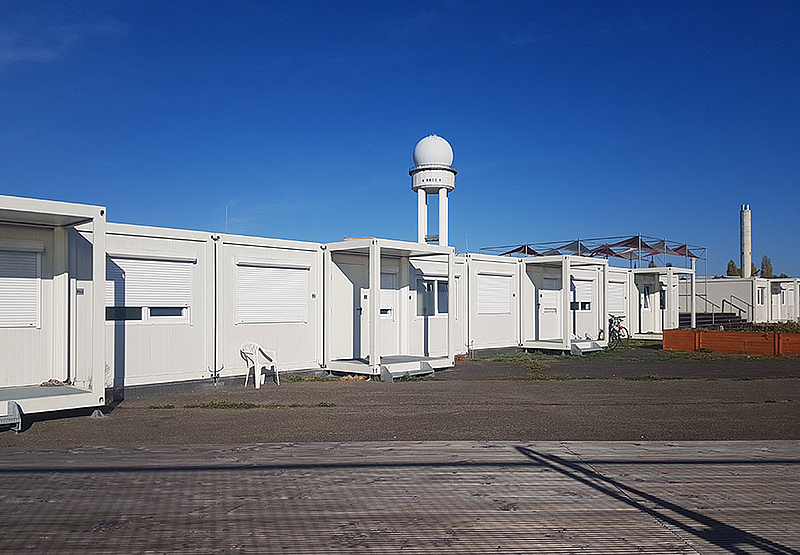
'Nicht-Wohnen' - Container-Siedlung Flugfeld Tempelhof