
"Living history on porcelain" // “Peace at the garage ”
That way the one that you're talking about will be a namesake.
I am in Kaliningrad. For three days the city is celebrating a festival of peace at the Dominsel - one of the rare sites downtown with buildings older than 70 years. Close by a well-kept square is standing out between battered and scabbed high-rise buildings. And this is not due to redevelopment measures in urban planning. The square is beautiful and looked after as there is a Soviet memorial. It says on a wall: "The homeland remembers." For eternity. Carved in concrete. At the square a torpedo takes to the skies, seemingly defying gravity, carried by the souls of those who gave their lives for the country.
A memorial in a public park leading to Lunapark is dedicated to all soldiers killed in action in Afghanistan, Chechnya, Cuba, Syria, the sorties in Egypt, Yemen, Cambodia, and Vietnam - just to mention a few of the battlefields eternalized in marble.
Into town, streets are paved with broken fragments of the city's history - carefully displayed on blankets. Königsberg's commemoration is to be found on broken porcelain and ampullas. It is for sale.
Likewise, shattered into pieces the remnants of a Damascene parlor - that once was a living room to Housam, Ruba, Khaled, Sham, and Nour - sparkle. Life of one's own becomes an archeological excavation to preserve memory.
Seemingly modest compared to the Russian memorials is a print, showing two boys in yellow life jackets. One puts his arm around the shoulders of the smaller one as if to protect him. The boys are Mohamed and Zajin immediately after being rescued from sea. Mohamed and Zajin live at a hotel together with their mother Hijba, whereas their father Mazin lives daHEIM.
Among others, Dakel writes about them in his paper "Peace at the garage."
He might as well call it "About living in HEIMlessness," "Large scale longing," or simply "Pain."
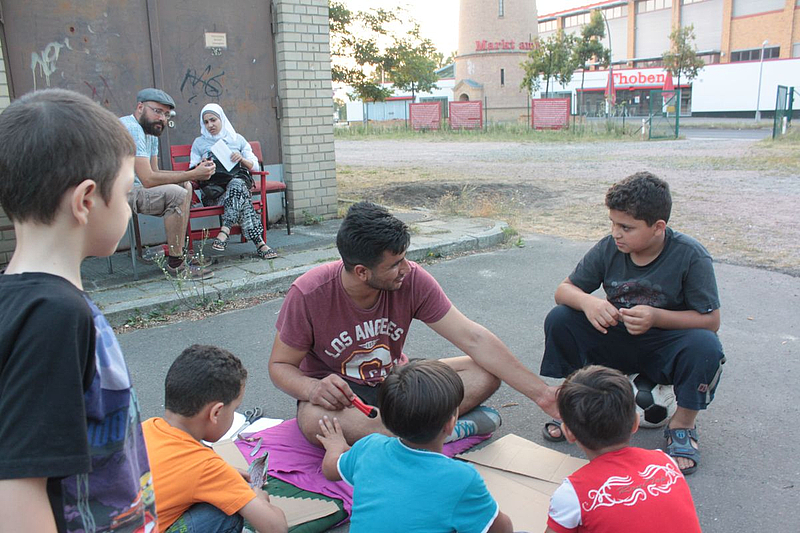
"Ever since the Zaibak family lived at HEIM, Tasnim had never arrived that late in our court," Dakel writes, only to add that Aymen and him kept answering all questions about where I was that I would be back the week after. However, everyone kept asking.
Apparently, the kids had snatched a photograph of me and then Samah prompted him to call me and ask me to come back to daHEIM. Then, he would quote Mohammad Zaibak's questions:
"How come we're not a family?"
"Why don't we help one another?"
"Why don't we form bigger concepts?"
"Why don't we turn daHEIM into our home?"
Dakel tells the story of when Hjiba, Mohamed, and Zajin came to visit and how Mohamed - that is Mazin's Mohamed - would sit together with the others on a rock, crying and asking:
"Why is everybody leaving?"
"Why does no one care?"
"Why doesn't anyone love me?"
"Don't you love me neither?" he would then ask Qais and "Where is Barbara?"
This is when he would stop crying and with a smile he'd say: "I'll be back next week and then we'll plan anew."
Meanwhile, Anatol would work without cease on the dresser, Dakel writes. His answer to all questions would lie in the word "control." Even when Aymen would ask him to have coffee with him, his answer would be "no, control."
When he, Dakel, would go to the garage to get the camera, Anatol would stop him, humming and smiling, and point to a pigeon: "good --- control."
"I didn't know what he was trying to say," Dakel would finish, "until Aymen came into the garage, saw the pigeon and said: peace in the garage."
Addendum:
When talking to Dakel he mentioned that Khaled, who moved out a few weeks go, came to visit. Apparently, he said to the other children: "You should play. Play! In my house I have a TV and a computer. But I don't have any friends."
"Then," Dakel would close, "he asked me at least three times, whether there was no room available. He would love to come back to daHEIM."
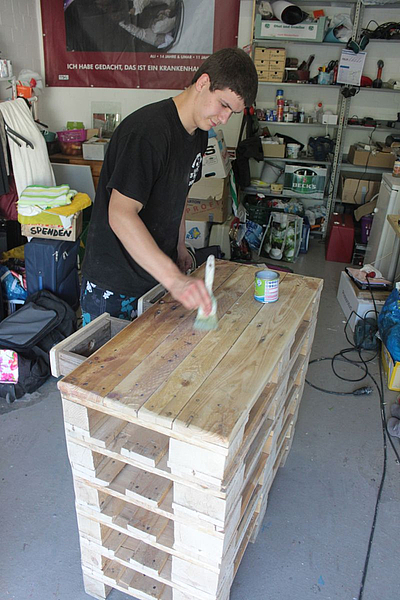
Anatol
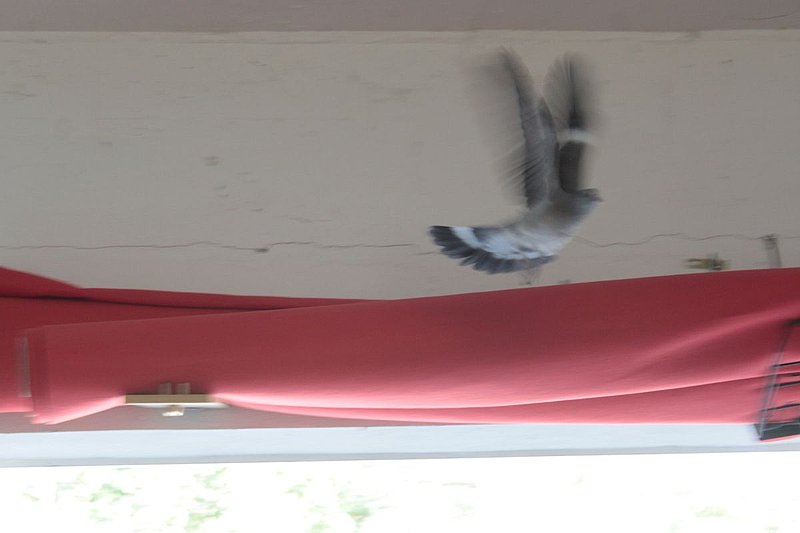
The Garage Peaceful pigeon
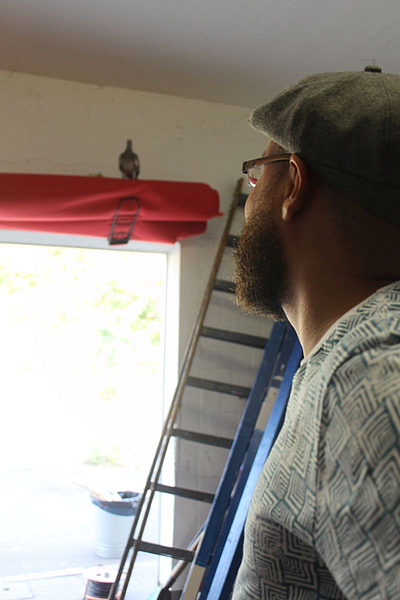
Aymen
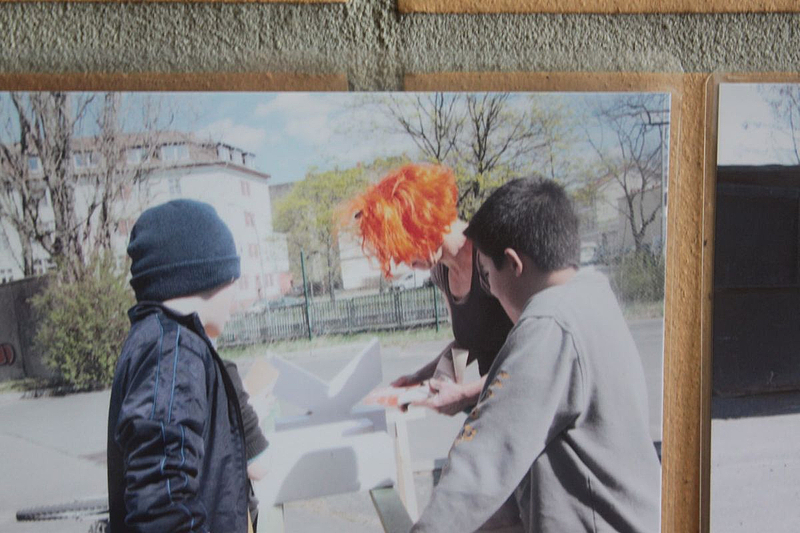
Denis | Ali | Dakel | Mohamed | Zain | Mohamed Zaibak